Tag Archives: Nayani Krishna Kumari

POET’S WIFE by Nayani Krishna Kumari.

There are only two characters in this story—the Poet who just returned home and the wife busy with chores at home. Between these two characters, there is the pen which is busy chiseling the letters, passing comments off and on, and babbling some silly things. This pen never learned to keep quiet.

“Lakshmi, Lakshmi,” the poet called a few times. His voice rose higher and higher, reached the highest note and then stopped. Lakshmi did not come into the room. The wicked wife not coming into the front room.
powife

“Huh. My voice’s getting gruff. This wicked witch of a wife hears me and still does not reply,” he told himself.

True, she heard his voice and not replied. She has not replied verbally; she walked in slowly. She came in, dabbing her wet hands to her saree palloo gently. “What is it, Sir! You’re shattering the tiles on the roof,” she said with a smile. She was watching the glow on his face in the light spreading from her moonlit smile. Her husband had the most beautiful face. He had a face that could put a value on her life.

“Oh, Devi[1]! The Generous one! The Woman with a heart brimming with waves of kindness! You’ve finally taken pity on this poor soul,” the poet knelt in front of her. Little waves of the river mandakini danced in her heart. That was the kind of dance the poet would describe in his poetry, she thought and suppressed a smile. She held her right hand in abhayamudra[2]. The poet was tickled at heart as he watched the tender palm.

“Um, come on, quick, speak your wish or else you’ll receive not a boon but a curse,” she said. The wife who had surrendered her entire life to the husband on his knees, was telling him that she might put a curse on him.

“May you grant me a strong cup of coffee,” he said gravely.

His eyes shone as they reflected the sheen of her teeth. The poet’s wife’s eyes turned toward the kitchen but her heart stayed put with the husband.

“Do not add too much sugar, Devi! May you be blessed with good grace”

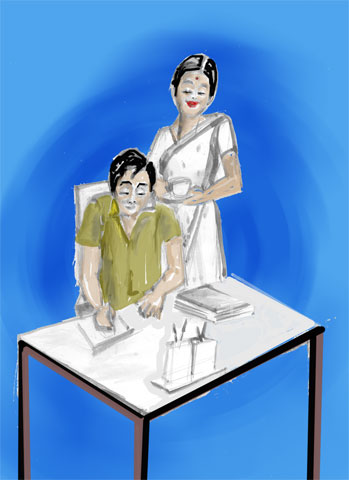
The poet’s heart bubbled with joy. The muse in him gathered strength. The luster from her face was spreading over his heart like the rays of light. His hands fumbled all over the table and pulled out white papers. The pen’s cap settled on the back end; the pen was ready to smear the white pages.

Poet’s wife walked in with a steaming cup of coffee.

“What’s that?” As she handed him the cup, her mouth spit those harsh words. Her devotion to her husband surged in her heart yet remained silent.

Poet took the coffee.

Wife stood behind his chair and started playing with his hair. “Bavaa,” she called him softly.

Poet’s heart was moved. The term bavaa from his wife, his maternal uncle’s daughter, sent his heart into raptures. Poet flipped his head backwards; his eyes met hers.

“Shooting a sammohanastram[4]. What’s the story?” he asked.


Poet was writing not only poetry but fiction also. His wife wrote nothing. She would listened to his stories, enthralled. In her mind, her husband wrote poetry much better than all the others.

”I don’t have any story to tell. You’re the two-penny writer. You would write some rubbish, call them your stories, and boogie around like a monkey,” she said. She told herself that she’d expressed her anger very well. She was annoyed because he was playing with his papers instead of talking to her.


“Whatever has gotten into you? It seems your father’s created you only to chew me up,” poet said. These words did not emanate from the bottom of his heart but only from the tip of his tongue. She would not chew him up, would not be able to.


“Bless you and your mother for thousand years. What’d I care,” poet’s wife said. Her feet turned towards the kitchen. They were like swans in the poet’s heart, her face was the lotus in it, her arms the stalks, and the green saree she was wearing was a throng of moss. Poet’s heart swung rapturously.


“What could I say anything about you? You snap for nothing. Yet you’ll say all kinds of things about my writing, is that it?” poet spoke the truth. He did not say anything about her. Poet’s wife bit her tongue. Honestly, she did not say anything about his writings either.


“What’s it then? You sit there with those stupid papers and pen forever. Do you think ‘wife’ does not mean as much to you as those stories?”


Poet’s heart laughed aloud; he laughed because this woman who held the rudder of his lifeboat was speaking meaningless words.


“No, my queen. Excitement is the foundation for poetry. And who’s the foundation for that excitement? Your eyes which, like fish, swim in the beauty of your face, the more I watch you … the more I spend time in your presence, … and .. and …” He wanted say a lot more but words failed him. Words have been always like this … never came to his mind when needed; they’d show up only after the need was gone. Poet’s eyes wandered around in the four corners of the room, prayed to the cobwebs for words and returned.


Poet cleared his throat and said, “My life’s aim is to portray you, the very manifestation of my life, in undying letters and present to the world as a gift. That is my single goal in life; my single exercise. You are a goddess to me, a genuine lover and my dream girl.” The poet was caught in a stream of poetry.

Poet’s wife was listening. She was on the ground but his words sounded like they were from out of this world. She felt like she was lost, bathing in the celestial mandakini river surrounded by kamadhenu [the heavenly cow], kalpavruksham [the celestial tree] and the parijatha flowers in the heavenly garden, nandanavanam. Her husband was not just a husband but the lord Indra himself.


“Stop Swami[5]. Crazy men are better compared to you poets, I suppose.”


Poet’s wife knew that poets and crazy men belonged together. Her husband was not only a poet but also was madly in love with her.


“That mischief of yours is inborn I’d say. You are my arthangi [one half of husband], the woman who should be holding my hand and walking me through life. And yet you snap at me and my poetry even if I say so much as an ‘um’. What am I supposed to do? Tell me, is my poetry asking you for food or water?”


True, his poetry did not demand food or water. Not even did it [the poetry] find the means to provide food and water for the person who had loved it and created it. Poet’s wife knew that.


“Would be nice if it had asked. I would’ve tied it to a pole and fed him some garbage,” she said.


Poet felt sparks in his heart. His wife was a good match for him.


“Come on Lakshmi, you’re not towing its load, are you?”


The pen told itself no need for any comments here.


Husband and wife were engaged in a heart-to-heart talk.


“You can say that again … You are not speaking even one word with me. As soon as you walk in, you start your affair with that pile of papers. I don’t have a co-wife but there it is, a bigger one.”


“You! God bless your home. That’s what you’re complaining about? … Is it about only talking, or, are you planning a trip to some place too?”


Poet’s wife did not speak. The pen thought there was nothing wrong in adding a comment here since the poet’s wife was quiet.


Poet approached her, held her chin gently. She pushed him away. The bangles on her hand jingled. Without another word, poet went and sat in his chair.


He said, “Oh god! I asked you for a wife and you gave me a brahmarakshasi. [high rank demon]”.


brahmarakshasi would not have smiling eyes or dainty nose, and certainly not the skill to overpower one’s heart. Poet’s wife possessed all these qualities. Therefore she was not a brahmarakshasi. And poet knew that.


Poet’s wife was not speaking yet.


“I wish I could ditch these mundane ties and go away to Rameswaram or some other place,” he said.


Poet’s wife moved; threw piercing looks at him. She said, “Stop it, stop that ghastly talk. If that’s the case, why marry at all? Who asked you to marry?”


Poet laughed. He laughed freely like a child. He said, “If somebody asked me to marry, I would have told her ‘no’ straight to her face. How can I look into your face and say no?”


Poet’s wife budged. She moved, walking in consonance with the flow of blood rushing in her veins. She came close to the poet. She knelt, held the arms of his chair; her eyes stared into his.

“Huh, that’s so unfair! Did I ask you to marry me? What a shame, bavaa?”

“Yes, my uncle’s daughter! Do you have to open your mouth and ask? What about your eyes? Did they let me stay still for a second? Didn’t they chase me like bullets from a rifle? Do you suggest I take the bullets and die? Don’t I savor my life of one hundred years like everybody else?”


Poet’s wife struggled to suppress a laugh. She bit her lip with front teeth. Her entire face became a camphor cube lit up, meant to hold a victory harati to the poet. She said, “You’re devious poet. Had I known, do you think I would have married you?”


“Well, that has happened. Let it be. Divorce me and find someone else.”


“Where is the assurance that he also wouldn’t turn out to be a poet like you? Nowadays where is a man who has learned the alphabet and not babbled or scribbled some nonsense?”

The poet thought that his wife’s question was a good one. The question however did not remain a question but gave rise to another misgiving. That misgiving worried him. For that worry to come out, his face changed expression and assumed somberness.


“Okay Lakshmi, I have a question for you. I’ll ask and you answer.”


Poet’s wife was disconcerted for a second. In her mind, a change in his tone caused the worlds to collapse; she collected herself and glared into his face sharply.


“Ask,” she said.


“Lakshmi, Would you really call my writings are also worthless trash, like those written by all those who had just learned the alphabet and scribbled?”


Ha, Is that all! Poet’s wife laughed. Relieved, her runaway heart returned home. Her impish brain popped up as usual and bopped like a kid.


“What do I know, sir. Am I a poet? Can I write? Why ask me about the good and bad in your poetry?”


“Stop it. Whom can I ask if not you? Who else has the power to evaluate my good and bad qualities?”


Joy erupted in the heart of the poet’s wife. It rose ferociously like the river Godavari on a stormy day and flooded; washed away her consciousness of the world, the people, and the daily activities in her memory.


“When I read your writings, I think that my husband is a gem among poets and then my heart runs over.”


“Really? Is it true, my queen? In that case, I don’t care even if the entire world assailed me and my poetry.”


Poet’s face turned red with excitement. Poet’s wife chided him gently, “Ssh. This is what bothers me about you. Too much excitement?”


“Without excitement, where is the poetry, you silly? You see, right now I am in a mood to write one hundred poems about you—the way you stand, the looks your eyes disperse, the beams of light your face displays, … and … more….” Poet wanted to say a lot more. But words were not coming to his rescue. These words had been always like that. They would not come to mind in time of need. Poet was lost in thought. His eyes were staring at the ceiling. His heart was not to be found anywhere in the vicinity. Poet’s wife was troubled.


Bava, hey bavaa! What’s that? A fit of excitement?.” Her two hands seized his shoulders, shook him and then let go.


God bless you! Keep quiet for a second. I am on to a good poem.”


“That’s enough, that’s cute. Don’t make all my labor bite dust.”


That was hard! What’s that? Suspicion sprang in the poet’s heart.


“Don’t you remember what you’ve just said? We’re going on a trip, straight to the Royal talkies,” she said.


A big boulder descended in the poet’s heart. The thrill of his poetic brilliance was gone. Even the beautiful poem which was about to come out was gone. The Royal Talkies turned into a planet at his heart and wailed for help.


“We’ll eat and then go. See how fast I’ve finished cooking the food—your favorite potato curry. Get up. Why waste time?”


Poet was still in daze yet heard his wife’s voice. The potato cubes, cooked, peeled, and fried zesty brown were twirling around in his heart. But he was not enthused. There was no sign of poems shaping up in his mind anymore. Well, the potato cubes would not make the right stuff for poetry.


“You’re not going to get up,” she said. The Poet’s wife referred to him as meeru or nuvvu depending on what she thought of him—husband or uncle’s son at any given moment.


She assembled the papers in front of him, capped the pen, seized his hand and dragged him towards the kitchen, to serve his favorite potato curry and tell him to take her to the movies.


The form of the wife who had been nurturing him so fondly was glowing in his heart even more charmingly. But it would not be impossible for him to write poetry in that moment. His wife would not let him.

[End]

Translated by Nidadavolu Malathi and published on thulika.net, February 2008.

————————————-

[1] Goddess.

[2] A hand gesture usually associated with gods and goddesses granting a wish.

[3] Mother’s sister’s son. In Telugu homes, the marriage between cross-cousins is permitted.

[4] An arrow, sanctified with a particular mantra, is capable of causing delusion in the person hit by it.

[5] Commander, Chief.

[6] The wife uses second person, singular, informal nuvvu , and formal meeru based on her assessment of the situation. These two forms are translated as “you’ in English. Only those familiar with our culture can understand the way the wife plays on the two terms.


MY MUSE! by Dr. Nayani Krishna Kumari

Like the nectar

Permeating the

sprouting bud

My poetry

oozes love

for my fellow humans


No

Thick-knit poetic

display of heavy phraseology

No fireworks

It is–

Not a glitter of gold

Not a goblet of honey


MY poetry

carries

no spite for the world

But emits

A sweet aroma

of the champaka flower

You call experience


My poetry

Does not chant

Washed-out phrases..

Like used up manthra

Does not

growl like a dog…

Hoping

the world to

back off

with her tail

between her legs


If I plunk

My frustrations

and blame it on others


My muse

Gawks at me

like a mother

enraged by my inanity.


My muse will never

Separate me

From the world ‘n

Fix on a pedastal.


My poetry

Springs not from sorrow,

Tears are not

My inspiration.


It compares not to

The fanatic world

To revel in the past

nor will it ignore the present

It is no

Weakling to curse the present

And Wallow in a fit of despair.


My muse

Dispels the gloom

And envisions the future

It gleams

like the morning reflection

in a dew drop

My trust abounds my muse.


My muse

Will kill the ill-will

And articulates ME!


THE BLAZING CHILD

[Telugu original entitled Agniputri]


My heart is

Like a thin dark veil

Like the sky taking shape—

Indolent and crimson

and dabbed with the evening hue


Dropping from

Heights unknown

and

gliding off the

Brick walls at the horizon

Flames of frustration

Rising Like metaphors


The drowning beams of the sun

Fighting To stay

The engulfing darkness


The nondescript creatures

Incomprehensible

Even to

My wildest imagination


The flies

Hovering incessantly

Around

The rays

Forming budding sprouts


Some

Aweful noise of

some wiggly

Creature stirring inside

My head


The sounds of

Little red scorpions

Etching question marks

On my brain


The eyes

are not showing

the bright red desires


No visible hopes

of rainbows

in the sky.


No magic flutter,

No shimmering wings

called hope.


These

Blazing blue flames

Are shrouding the

Internally fixated conscience.

In my state

Of Uncertainty

Not knowing

What I want and

What I am searching for

And that’s scaring me out of wits!

***


(Telugu original, agniputri, published in Bharati, 1970)


I’M THE OCEAN!

 The tiniest wave

Born in the

Viscera of the ocean


Wakes up,

Slender and tender

Like a creeper on the fence

Soon to rise

Like a ferocious Lion

Giving in

To the surges of water

And gusts of winds.


The desire

in my heart

Is just a speck

at the start.


As the

Opportunities appear

Round the corner

Blaming the

Elusive pegs on which

It Could hang on,

Blasts off

In an undue outburst

Escalating to new heights

Unrestrained.


The Desire,

Confusing and startling,

Turns into

Stormy seas

Causing turmoil

In my mind.


The Desire

With its

Incessant attacks

on Me


Knowing

I’m defenseless

And vulnerable

Probes deep Into the

Innermost corners

Of my heart

And is

Turning me

Into numb

Sea sands on the shores.


The Desire is

Frightening

My wits.

Casting a spell

“You turn to a Stone

You be Ahalya[1]

Utters ruthlessly.


Hence

I bear in mind

Each time

I see the sea

It reminds me

With its

Constant uproar

And commotion

The self I am

The unfathomable bond

Between me and the sea

Continues to baffle me forever.

***

[Published Telugu original entitled nenuu-samudram in Bharati 1970]

Translated by Nidadavolu Malathi and published on thulika.net, December 2002 

————————–

[1] In Hindu mythology, Ahalya was the wife of Sage Gautama. Suspecting her of infidelity, Gautama curses her to turn into a stone, later to be redeemed by Lord Rama.

Ants

By Prof. Nayani Krishnakumari.

Ants are small. They are very small compared to the mighty human beings. Yet the strength of human beings is useless compared to the strength of the ants. They would crunch our bodies into tiny bits ruthlessly and drag them into their abodes. There is that kind of brutality in the redness of those ants. The power of animosity is latent in their communal spirit, which could shatter the smugness of human beings. As long as one is in a state of deluge there is no stopping to their attacks.

Murali is 38-years old. He was watching the ants as they moved in a row methodically. He was struggling to keep his eyelids open to watch them. A thin veil spread in front of his eyes. Each ant turned into one thousand ants and looked like a huge expanse of the ocean. His body quivered at the thought that these ants could turn into waves and drown him. What if these ants surround him, maul his muscles into small bits and drag the pieces into their anthills. The fear made his palms turn cold like snow.

In front of him, a white bottle of cheap arrack, shining bright, was sitting on the table. The glow of the battle scared him. He heard loud sounds and felt warm fumes coming out of his ears. His heart could not accept the pleasure the body was enjoying the liquor. It was riveting. His heart was heavy as if grappling with meaningless matters. Why he had to continue to live in such a state of confusion was beyond his comprehension.

Murali exerted himself to keep his eyelids open and look at the ants. The table in front of him looked like two tables. Around the table, on the floor bits of omelet and green pepper scattered all over and made a mess. The red ants were trying to drag one of the omelet pieces. The ants besieged a piece of omelet and covered it completely, looking like a ball of pins. The piece, being dragged by the ants, was looking like a puppet in the hands of fate. Murali could not focus. His brain was filled with the thoughts of his past.

Murali has earned the reputation as a smart student during his college years. He was at the top of his class in all the subjects and extra-curricular activities. He was a happy young man, always laughing and making others laugh. At home, his brother’s children used to behave properly in his presence. His sister-n-law would say, “There is chinnaayana,” to keep the children in line. His older brother, Balaram, loved him very much and believed that Murali was born to save the family’s reputation.

Whenever Murali visited his brother’s place, he took the children to the shallow well[1] outside the village and gave them swimming lessons. Or else, he would be busy changing light bulbs, fixing ceiling fans, broken radios and such things in the entire neighborhood. Or, he would get the children together and help them with their studies. When chinnaayana was around, even the hardest math problem was solved in a snap by the children. They feared him to a point; they would not ask his permission even they had to go to the bathroom.

Murali became tense. He wondered, “Am I the same Murali? I am living like a frog in a well. People and situations are attacking me like ants and I am giving in. They are mashing me into bits and pieces and dragging me into their holes. I must fight back. I must,” and he kept beating himself up. The entire world around him was rocking like a swing. It was laughing at him in a roar and swinging briskly.

***

Murali earned his degree in veterinary science and a job fell into lap right away. He started his life as a veterinary doctor in a religious town on the banks of a river, away from the city. That pious town which offered solace for millions of people directed him to seek a different way of life. Well, maybe not. Poor thing. What did the town do? Not even the god could help him. The God was there lying motionless for centuries. He did nothing. But the people who pushed Murali around were different. Compared to himself, they were mean, like these ants. Murali’s body quivered in a state of stupor. The neon bulb above, which was spilling baby smiles until now, started turning gray.

A series of episodes went through his mind like in a movie.

Through the folds of that dim light, Nilayya, tall and dark, burst into a big laughter. His teeth were white but underneath that whiteness, Murali could clearly see the shades of his crookedness.

Murali said, addressing the thin air in front of him, “You, Nilayya, you brought me to this condition. You are small like these ants. Yet, when ants like you team up, even the strongest serpent has to surrender. I surrendered to you, I mean it. I threw myself at the feet of these tiny ants.”

Sangayya stood in front of Murali, “Am I not here, sir? You remembered Nilayya. What about me?” Sangayya also was laughing. He was laughing displaying his red-stained teeth. His eyes, filled with red streaks, looked frightening like a cluster of red ants. Arrack dishes and other things were hovering around him. Murali was shivering. He was filled with repulsion and panic; he could barely hold himself straight. He felt like he would fall down, if he tried to stand up. “I am being attacked by all these mean people. They are chewing me up. I must shake them off. How? How?”

Sangayya is the arrack shop owner in that town, and the sixth sense for Nilayya. It is customary in that town to auction the arrack shop each year. He, who bids the highest will have control over the shop for one year and take care of the business. Sangayya always bids the highest. He is of heavy build, dark-skinned, and has thick lips and thick eyebrows. He looked scary. If he were cast in the role of an ancient Dravidian king, he would certainly steal the audience. The arrack shop has stone slabs and a high-raised cement bench. When he sat on the cement bench and carried on his arrack business, selling huge pots of arrack, he would look like a king short of wearing a crown.

Sangayya, in addition to arrack business, also had a herd of cows. Since milk and arrack are equally welcome in our country, Sangayya fared well in both the businesses. Anytime one of his cows was afflicted with some disease or other, Murali was the Lord Krishna Himself as far as Sangayya was concerned.[2] Murali has that magic touch in his hand. Whenever somebody brought a sick animal to him, he would not stop debating whether the owner was rich or poor. His only concern was the welfare of the animal. If one could read the animal language, one could read in their eyes, “Murali is my mother, my birth mother,” no doubt in that.

In Murali’s mind, Sangayya was ready to break down as he said, “For that very reason, you are like a god to me. I listened to Nilayya and believed that drinking was good for your health. I was the reason you’ve taken to drinking. I ruined you completely.”

“Well. How can I blame you? You did not tell me to get addicted to the arrack bottle. I got myself into this mess. No, Sangayya, actually, Nilayya joined hands with that Sher Khan and dragged me into this muck.” Murali’s body was losing control but the mind was still sharp. The thoughts of past were hovering in his head, all mixed up and baffling, with no sign of taking any logical form.

Normally, the veterinary doctor has an additional responsibility, besides treating the animals. That is about the animals brought to the slaughterhouse. The veterinary doctor needs to certify which one could be slaughtered and which one is not. Without Murali’s stamp of approval, the animals were not eligible for human consumption. It is in that context, Sher Khan entered into Muali’s life. The animal nature that is part of his name[1] is also evident in his lifestyle. As far as he is concerned the entire world is a huge slaughterhouse. In that world the people whom he did not like are the animals. And the people whom he liked are the clever persons who would turn the first category people into pieces of meat and make money for themselves.

Khan understood money very well. Money is like the blood that a tiger relishes when she bites into the neck of a goat. Money is the thing that furnishes the several amenities, warmly, solidly, and strongly until one got sick of it. The humans would do anything to obtain that sick feeling. In order to accomplish his goal, he viewed the world as a goat on the butcher block, waiting to be chopped by his butcher knife. But his tiger nature did not touch Murali.

***

One day Sher Khan brought some animals. Murali examined them and said, “Who handed them down to you? These animals are not good for humans.”

“What can we do, babu? Nowadays even we humans don’t have enough to eat. No surprise the animals got sick, what else would you expect of them? You go ahead and approve them. I will make sure you will get something out of it.”

Murali was ticked off. He could not make out whether Sher Khan was preaching him or telling him. “What do you mean? What are you thinking? Am I working for the government or you? I am the one to decide whether the animal is fit for butchering or not. You can butcher and sell only after I say so.”

Sher Khan was stunned for a split second. So, now, after all these years this person was man enough to challenge him! His ego started out in his heart and jumped to his throat but Sher Khan stifled it right there. He begged Murali with a very sad expression on his face and both palms clasped. But Murali was stubborn. He was the kind of a man that would keep arguing even when he knew he was wrong. There is no saying what to expect of him, when he was not in the wrong. As a result, the lifespan of the animals that came to the slaughterhouse was extended for the day. That is when the consolidated strength of the ants came into play.

Did you ever watch the ants move methodically in rows and in a straight line? One ant first comes from the opposite direction and taps on the noses of the rest, one after another, in the row and thereby passing on the word. That’s it. All the ants together put the command into action. They all, together, attack the bug, overtake him and carry them to their anthill. The first one that brought the news would not join this crowd. She assumes leadership and keeps the rest of the ants in line. That is how Sher Khan acts precisely.

Nilayya and Sher Khan are good friends. Nilayya cannot go against Sher Khan’s will and survive. Nobody can survive for that matter. Nilayya is worldly-wise; he shows great humility and gets his job done. At the same time, he could be overly cruel when it comes to dealing with his inferiors. The knife in his hand is double-edged. Nilayya works for Murali. Despite his job as a lab assistant, he was also running errands for Murali. It is with that kind of service, Nilayya earned an enormous amount of trust from Murali.


The equality and social justice that the politicians lecture about are flowing in Murali blood. He would walk around on the streets with his arm around Nilayya’s shoulder openly.[3] His trust in Nilayya took him a little too far. The clinic was filled with expensive medicines and medical equipment. It was Murali’s responsibility to check the stock and sign off the register, indicating the usage each day. Yet, if Nilayya brought the stock register, Murali would sign without looking at the numbers. Sometimes he would even leave the keys with Nilayya.

***

The bottles in front of Murali are empty. Numerous colors were floating in his head like the fireflies and worrying him. He kept beating his head and talking to himself, “Nilayya, I must give it you. You are really something. You ruined my record. He presented me to the public as a criminal. You said it feels good and got me into this drinking habit. You tried even to implicate me in the murder of Reddy. Poor Reddy!”

Nobody can understand the atrocities of Nilayya unless they knew Reddy’s story. In that village, the hospital and the panchayat[2] office were housed in the same building. The two offices shared the same entrance. Reddy was surpanch[3] of that village. We cannot say he was like Rama simply because the first part of his name is Rama in Ramachandra Reddy. Rama of the puranas was expert politician; when his stepmother told him to go to the woods, he followed her command and took his wife and younger brother along with him.[4] This Reddy on the other hand is very well-versed in local politics. He has mastered the skills, like the moves in the game of chess, necessary to keep his chair forever. For the same reason many people in the village hated him. He also acquired some vengeful enemies who were knowingly or unknowingly wanted his guts. One day somebody murdered Reddy while he was in his office. The instrument that was used for that purpose was the scalpel from the veterinary hospital.

“Hey, Nilayya! Reddy would care for nothing except his chair. Whatever did he do to you? You, rascal, how did the murderer get our scalpel? The scalpel is intended to cut the thick skin of the animals. Human skin is no problem for it at all, right? Who is responsible for all this?” Murali was shaking like a man possessed. He was losing control of himself. The liquor and the thoughts of his past were buzzing through his head and baffling him. “When the Block Development Officer came for inspection you played a game I could not believe. Was I really responsible for all the lost medicines and the equipment? You got me into this habit of drinking, forced me to borrow money, and stole my salary from my pocket while I was under the influence of alcohol. You, you provoked him [Sher Khan] by telling that I was responsible for his buffalo’s death. You told him that I was drunk and gave the wrong medication to the buffalo, how could you? The buffalos are dumb animals and I treat them like my own life.”

Murali was choking and gasping for breath and shedding tears. He could barely hold himself. He tried to get up from the chair and stand straight. His knee hit the table in front him. In an attempt to stop himself from falling, he put his right foot to a side. In the process his foot stepped on the crowd of ants that were dragging the omelet piece. So many tiny lives were crushed softly under his foot! Suddenly he felt something—a sense of fear or goose bumps—shot down his spine like a lightning. Murali’s brain shook off the numbness in a split second like a dozing traveler jolted when a bus came to a screeching halt. Murali came to his senses.

Murali lifted his foot and saw the ants flattened into a cardboard. He yelled, “Ho, Sher Khan, Nilayya, Sangayya, you are all ants. Look at them. Take a good look at them. They are all crushed under my foot and turned into chutney.” He burst into a big laugh. The entire house exploded with his laughter.

[End]

(The Telugu original Cheemalu has been published in the anthology, “Katha mandaram” compiled by Avula Jayapradadevi. Hyderabad: Andhra Pradesh Sahitya Academy, 1979.

Translated by Nidadavolu Malathi, and originally published on thulika.net, September 2003)

—————————–

[1] First part of his name, Sher, means lion.

[2] Village administrative branch.

[3] Village administrator

[1] In villages, some wells will have steps so people walk down to reach the water and big enough to swim.

[2] According to legend, Lord Krishna was born in the family of cowherds and was considered the protector of cows.

[3] This is an unusual practice for people from different social strata.

[4] An episode in the epic, ramayanam.